

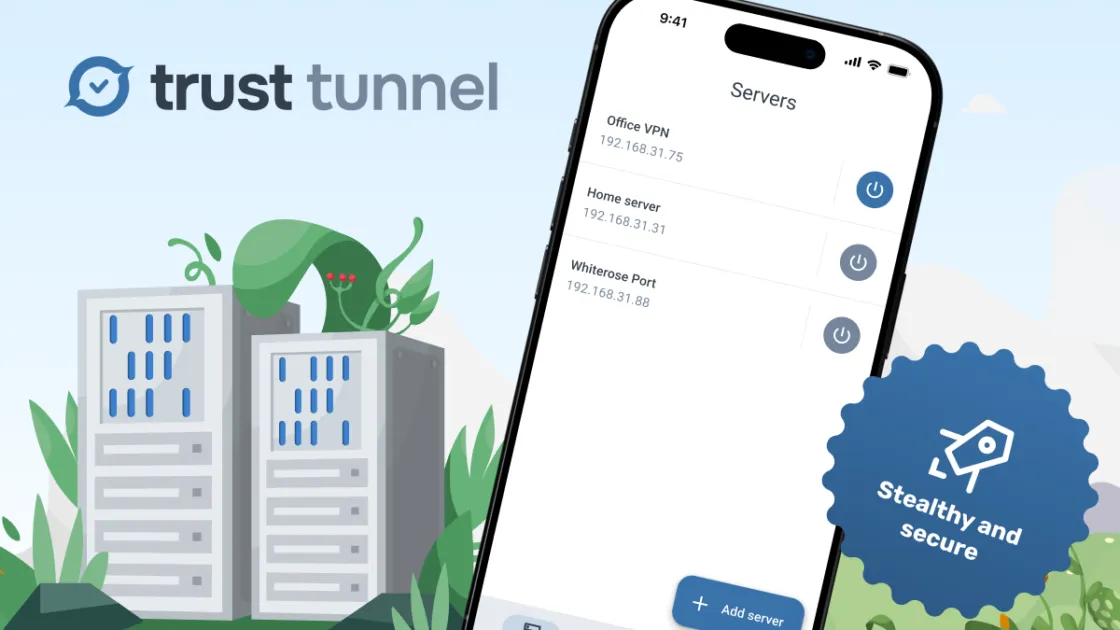
In the ongoing battle between internet censorship and digital freedom, VPN protocols have evolved dramatically. Among the most innovative solutions is TrustTunnel — a modern, open-source VPN protocol originally developed by AdGuard VPN and now available to everyone under the Apache 2.0 license.
What is TrustTunnel?
TrustTunnel is a next-generation VPN protocol designed to solve a fundamental problem that has plagued VPN technology for years: the trade-off between speed and stealth. Traditional VPN protocols like OpenVPN, WireGuard, and IPSec share a common weakness — they are relatively easy to detect and block at the network level. When attempts are made to conceal VPN traffic, performance typically suffers.
TrustTunnel takes a radically different approach. Instead of trying to hide VPN traffic, it makes it indistinguishable from regular HTTPS web browsing. When you connect to a TrustTunnel server, your traffic looks identical to someone visiting any ordinary website.
How TrustTunnel Works
HTTP/2 and HTTP/3 Transport
At its core, TrustTunnel uses HTTP/2 and HTTP/3 (QUIC) as its transport layer — the same protocols that power modern websites like Google, Facebook, and Netflix. This is a fundamental departure from traditional VPNs that use custom protocols easily identified by Deep Packet Inspection (DPI).
The protocol supports:
- HTTP/1.1 — for maximum compatibility
- HTTP/2 — for multiplexed streams and improved performance
- HTTP/3 (QUIC) — for the best performance on unreliable networks
TLS Encryption
TrustTunnel uses standard TLS (Transport Layer Security) encryption — the same technology that secures every HTTPS website you visit. This provides several advantages:
- Battle-tested encryption used by billions of connections daily
- Continuous security audits by the global security community
- Traffic that looks exactly like normal web browsing
- No proprietary cryptographic methods that could have unknown vulnerabilities
Stream-Based Architecture
Unlike traditional VPNs that process individual packets, TrustTunnel operates on data streams. Each connection gets its own dedicated HTTP/2 or HTTP/3 stream, creating a separate tunnel. This architecture allows:
- Packet buffering — multiple packets are combined before transmission
- Reduced overhead — fewer acknowledgment packets needed
- Better throughput — more efficient use of bandwidth
- Lower latency — especially on high-latency connections
Why Traditional VPNs Fail Against Censorship
Traditional VPN protocols have distinct signatures that make them easy to identify:
OpenVPN: Uses a recognizable handshake pattern and packet structure. Even when wrapped in TLS, the timing and size patterns often reveal its presence.
WireGuard: While fast and modern, its UDP-based protocol has a distinctive signature. It's also challenging to disguise because of its minimal packet overhead.
IPSec: The protocol headers are standardized and well-known, making detection straightforward for sophisticated firewalls.
When these protocols attempt to hide their traffic (through obfuscation layers), they typically introduce significant performance penalties. TrustTunnel eliminates this trade-off entirely.
Traffic Types Supported
TrustTunnel can tunnel multiple types of network traffic:
- TCP — for web browsing, email, file transfers
- UDP — for gaming, video streaming, VoIP
- ICMP — for network diagnostics (ping, traceroute)
TrustTunnel vs Reality Protocol
It's important to distinguish TrustTunnel from another anti-censorship technology called Reality (part of the XTLS/Xray project). While both aim to evade detection, they work very differently:
| Feature TrustTunnel Reality | ||
| Transport | HTTP/2, HTTP/3 | VLESS over TLS |
| Approach | Mimics HTTPS traffic | Borrows TLS fingerprint |
| Server Setup | Standalone server | Requires "dest" config |
| License | Apache 2.0 | GPL |
| Developer | AdGuard | XTLS Project |
ASMO360 VPN supports both protocols, giving users the flexibility to choose based on their network conditions and requirements.
ASMO360 Implementation
In ASMO360 VPN, TrustTunnel is implemented as a dedicated VPN service alongside our Xray-based protocols. Our implementation includes:
- Native performance — using AdGuard's official client library
- Automatic protocol selection — falls back to HTTP/1.1 if HTTP/2 is blocked
- Anti-DPI measures — additional obfuscation when needed
- Kill switch support — prevents data leaks if connection drops
- Per-app VPN — route only specific apps through TrustTunnel
- Split tunneling — exclude local network traffic
When to Use TrustTunnel
TrustTunnel is particularly effective in scenarios where:
- Traditional VPN protocols are blocked
- Deep Packet Inspection is actively filtering traffic
- You need to bypass network restrictions without sacrificing speed
- You're on networks that throttle VPN traffic
- You need a VPN that works on restrictive corporate or school networks
Open Source and Future
In early 2026, AdGuard open-sourced TrustTunnel under the Apache 2.0 license, making it available to the entire community. The project includes:
- TrustTunnel — the core VPN protocol library (Rust)
- TrustTunnelClient — command-line client (C++)
- TrustTunnelFlutterClient — mobile client (Flutter)
This means any VPN provider can now implement TrustTunnel, creating a more diverse ecosystem of censorship-resistant tools.
Conclusion
TrustTunnel represents a significant advancement in VPN technology. By embracing web standards rather than fighting against them, it achieves what many thought impossible: a VPN protocol that is both fast and invisible to censorship systems.
At ASMO360, we're proud to offer TrustTunnel as one of our protocol options, giving our users the tools they need to maintain their digital freedom regardless of where they are or what restrictions they face.